
Space Debris Crisis Orbital Cleanup Technologies complete
Nov 5, 2025

The Space Debris Crisis, often called "space junk," refers to the growing population of defunct, man-made objects orbiting Earth. This includes everything from entire dead satellites and spent rocket stages to tiny flecks of paint and fragments from past collisions.
The primary danger is their incredible speed. In low-Earth orbit (LEO), debris travels at over 17,500 mph (28,000 km/h). At this velocity, even a marble-sized object can strike an operational satellite or crewed spacecraft (like the International Space Station) with the force of a grenade, causing catastrophic damage.
This problem risks creating the Kessler Syndrome: a theoretical tipping point where the density of debris becomes so high that collisions create a cascading chain reaction. One collision creates thousands of new fragments, which in turn increases the probability of more collisions, potentially rendering LEO unusable for generations.
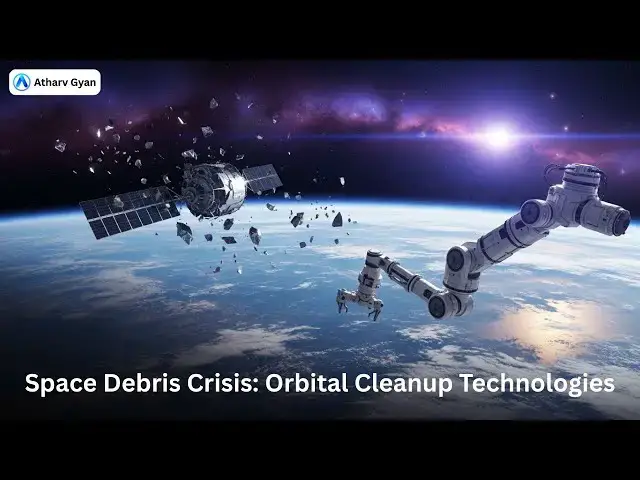
To combat this, Orbital Cleanup Technologies, or Active Debris Removal (ADR), are being developed. These are robotic missions designed to find, capture, and safely remove the most dangerous pieces of debris.
Key cleanup methods include:
Robotic Arms/Claws: A "chaser" satellite rendezvouses with a piece of debris, grabs it with a robotic arm, and then pulls both itself and the junk into the atmosphere to burn up on re-entry. (e.g., ClearSpace-1 mission).
Nets and Harpoons: Some missions are designed to fire a net or a harpoon to capture tumbling or uncooperative debris before towing it out of orbit. (e.g., RemoveDEBRIS mission).
Magnetic Capture: Some concepts involve equipping future satellites with a magnetic docking plate, allowing a "tug" spacecraft to easily attach and de-orbit it at its end-of-life. (e.g., Astroscale's ELSA-d).
Laser Ablation: This method involves hitting debris with a ground-based or space-based laser. The laser heats the object's surface, creating a small puff of gas (ablation) that acts as a tiny thruster, slowly nudging the debris into a lower orbit where it will eventually burn up.
#SpaceDebris #SpaceJunk #OrbitalCleanup #SpaceSafety #KesslerSyndrome #ActiveDebrisRemoval #SpaceTech #Aerospace #SpaceSustainability #LEO #Satellite
Show More Show Less